
Affiliate Disclosure: This article contains affiliate links. If you purchase a product through these links, SolarHomeGeek may earn a commission at no extra cost to you.
Installing solar panels is a major investment, and one of the first questions many homeowners ask is simple: How much roof space do solar panels need?
The answer depends on your solar system size, panel wattage, panel dimensions, roof shape, shading, and how much of your roof is actually usable for solar.
For a typical residential installation, modern solar panels can occupy roughly 20–22 square feet each, although the exact dimensions vary by manufacturer and model. The total usable roof area needed will also be larger than the physical panel area because installers must account for roof layout, access and required clearances.
How Much Roof Space Does One Solar Panel Need?
Modern residential solar panels come in different sizes and wattages. Many current residential panels are approximately 68–75 inches long and 41–47 inches wide, giving a physical footprint of around 20–22 square feet.
However, you should not calculate your entire solar installation by simply multiplying the panel’s physical dimensions.
The actual layout also has to account for:
- Roof edges and available roof planes
- Roof vents and plumbing pipes
- Chimneys and skylights
- Shading from trees or nearby structures
- Installer access and maintenance pathways
- Local installation and fire-clearance requirements
- The orientation and slope of the roof
That means usable roof space is more important than total roof area.
How Many Solar Panels Do You Need?
The number of panels depends primarily on your desired system size and the wattage of the panels you choose.
For example, if you use 400-watt panels:
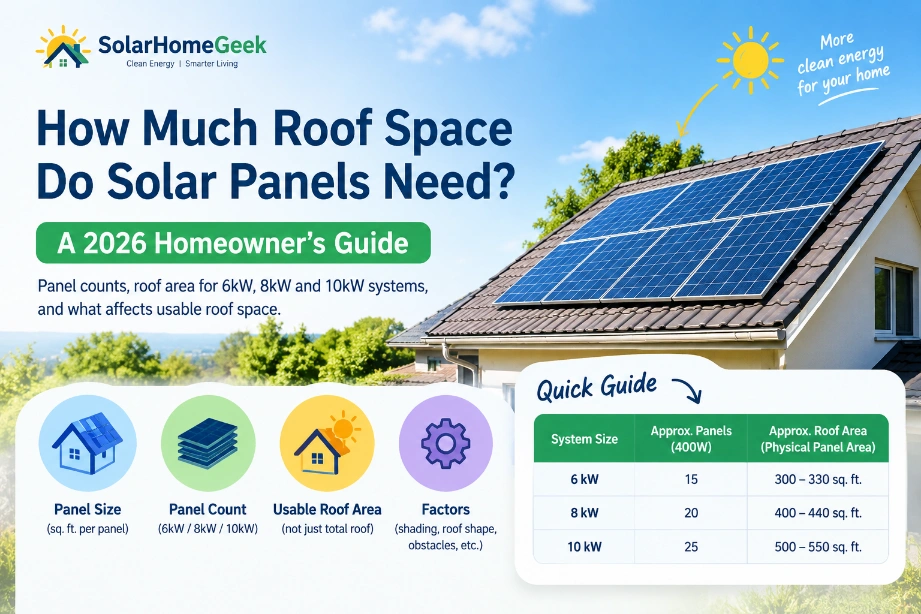
- 6 kW system: About 15 panels
- 8 kW system: About 20 panels
- 10 kW system: About 25 panels
If you use higher-wattage panels, you may need fewer panels for the same system size.
For example, an 8 kW system using 400-watt panels requires approximately 20 panels, while using 450-watt panels would require approximately 18 panels.
Simple Formula
Number of panels = System size in watts ÷ Panel wattage
For example:
8,000W ÷ 400W = 20 panels
This is only a planning estimate. Your installer should determine the final panel count based on your electricity consumption, roof layout and selected equipment.
How Much Roof Space Does a 6 kW Solar System Need?
A 6 kW system using approximately 400-watt panels would require around 15 panels.
If each panel occupies roughly 20–22 square feet physically, the panel surface itself would be approximately:
15 × 20–22 sq. ft. = about 300–330 sq. ft.
The actual roof area required can be higher because the installer needs to work around roof obstacles and installation clearances.
So, as a rough planning figure, homeowners should expect a 6 kW system to require several hundred square feet of usable roof area, rather than assuming that the entire roof can be covered.
How Much Roof Space Does an 8 kW Solar System Need?
An 8 kW system is a useful example for many homeowners because it falls within the residential system sizes commonly discussed in the U.S.
With 400-watt panels:
8,000W ÷ 400W = 20 panels
At roughly 20–22 square feet per panel, the physical panel area would be approximately 400–440 square feet.
The actual usable roof area required will depend on the panel dimensions, roof configuration and installation requirements.
Higher-wattage panels can reduce the number of panels needed, which can be particularly useful when roof space is limited.
How Much Roof Space Does a 10 kW Solar System Need?
A 10 kW system using 400-watt panels would require approximately 25 panels.
At around 20–22 square feet per panel:
25 × 20–22 sq. ft. = about 500–550 sq. ft. of physical panel area
Again, this is not the same as the total roof area an installer will need.
A roof with chimneys, vents, dormers, skylights or significant shading may have considerably less usable space than its total measured area.
Solar Panel Roof Space Quick Reference
| Solar System Size | Example Panel Wattage | Approx. Panel Count | Approx. Physical Panel Area* |
|---|---|---|---|
| 4 kW | 400W | 10 | 200–220 sq. ft. |
| 6 kW | 400W | 15 | 300–330 sq. ft. |
| 8 kW | 400W | 20 | 400–440 sq. ft. |
| 10 kW | 400W | 25 | 500–550 sq. ft. |
*Physical panel area is a planning estimate based on approximately 20–22 square feet per modern residential panel. Actual dimensions vary by model, and the complete installation may require additional usable roof area.
Why Your Total Roof Size Isn’t the Same as Usable Solar Roof Space
A homeowner might have a 1,500-square-foot roof and assume that most of it can be covered with solar panels.
In reality, only part of that roof may be suitable.
For example, a roof may contain:
- Large shaded areas
- Chimneys
- Skylights
- Plumbing vents
- Roof windows
- Multiple roof slopes
- Areas that are difficult to access
- Sections with unsuitable orientation
This is why solar installers normally evaluate the usable roof area, rather than simply measuring the total roof footprint.
Does Roof Orientation Affect How Much Space You Need?
Yes.
Roof orientation affects solar production, so two homes with the same roof size may not have the same solar potential.
A roof with a large, relatively unshaded solar-friendly area may produce more useful electricity per installed kilowatt than a roof with extensive shading or less favorable exposure.
That means homeowners should not choose a system size based only on square footage.
Your annual electricity consumption, local solar conditions, roof orientation and shading should all be considered together.
What If You Don’t Have Enough Roof Space?
If your roof cannot accommodate the number of panels you need, you may still have options.
1. Choose Higher-Wattage Panels
Higher-output panels can produce more electricity from each module.
That means you may be able to reach your target system size with fewer panels.
For example:
- 8 kW with 400W panels = 20 panels
- 8 kW with 450W panels ≈ 18 panels
The physical dimensions and efficiency of the specific panel still matter, so compare the manufacturer’s specifications rather than looking only at wattage.
2. Use Another Suitable Roof Section
If your main roof plane is too small, an installer may be able to use another suitable roof section.
The final design depends on orientation, shading, roof structure and local installation requirements.
3. Consider a Ground-Mounted System
Homeowners with sufficient property space may consider a ground-mounted solar array when the roof is unsuitable or too small.
Ground mounting can provide more flexibility in array placement, but it requires appropriate land, mounting equipment and local approvals.
What Should You Measure Before Getting a Solar Quote?
Before requesting a solar installation quote, make a basic list of your roof characteristics.
- Approximate roof dimensions
- Roof orientation
- Roof slope
- Major trees nearby
- Chimneys
- Skylights
- Roof vents
- Areas that receive heavy shade
- Roof age and condition
- Available open roof sections
Do not rely on a simple measurement alone. A professional solar design should account for the actual panel model and the roof’s usable area.
Can You Install Solar Panels on a Small Roof?
Yes, a small roof does not automatically mean solar is impossible.
The important question is how much electricity you want to generate and how much usable roof area is available.
If space is limited, higher-wattage and higher-efficiency panels can help reduce the number of modules required for a particular system size.
For example, if your roof can only accommodate 18 panels, using 450W panels could theoretically provide:
18 × 450W = 8,100W
That is approximately an 8.1 kW array before accounting for the actual system design and production conditions.
Useful Solar Equipment for Homeowners
If you are planning a solar installation, having the right measuring and monitoring equipment can make it easier to understand your home’s energy needs and available space.
- Solar panel measuring / inspection tools: Check Price
- Home energy monitoring device: Check Price
- Solar power meter / irradiance meter: Check Price
Final Thoughts
The amount of roof space required for solar panels depends on much more than the size of your roof.
Your electricity usage determines the approximate system size, while panel wattage determines how many modules are needed. Modern residential panels can occupy around 20–22 square feet each, but the final installation requires additional consideration for roof layout, obstacles, shading and installation clearances.
For a homeowner considering solar, the best approach is to determine your electricity needs first and then have a professional solar installer evaluate the usable roof area.
A larger roof is helpful, but smart panel selection and proper system design can make a significant difference when roof space is limited.
Frequently Asked Questions
How much roof space do solar panels need?
A modern residential solar panel may physically occupy around 20–22 square feet, but the complete solar array requires additional usable roof space for layout and installation requirements. The exact amount depends on the panel model and system size.
How many solar panels do I need for an 8 kW system?
With 400-watt panels, an 8 kW system would require approximately 20 panels. Higher-wattage panels could reduce the number of panels needed.
Can solar panels fit on a small roof?
Yes. Higher-wattage panels can help generate more power with fewer modules. However, the roof must still have sufficient usable, appropriately oriented and relatively unshaded space.
What reduces usable roof space for solar panels?
Chimneys, skylights, vents, dormers, shading, roof shape and required installation clearances can all reduce the amount of roof area available for solar.
Should I measure my roof before contacting a solar installer?
A basic measurement can help you understand your available space, but a professional solar design should use the exact panel dimensions and account for roof orientation, shading, obstacles and installation requirements.